- Purpose: distinguish direct output sequestration, substrate competition, generic shared-resource competition, and intentional useful coupling; define measurable effects; and bound claims about insulating module interfaces
- Evidence audit: interface-qualified retroactivity and insulation
- Experiment contract: Fixture F-027
- Result state: analytical definitions and synthetic experiment specifications only; every empirical, workstation, and energy result is NO_RESULT
Four coupling classes
Let an upstream module produce a signal for one or more downstream clients. Four effects that can look similar in a latency or output trace must remain distinct.
- Direct output sequestration or connection back-action occurs when the receiver binds, pins, drains, blocks, or otherwise changes the output carrier or producer-owned state that participates in upstream dynamics. Removing the output connection removes this path even when total work is held fixed.
- Substrate competition occurs when multiple downstream transformations compete for a declared pathway-specific enzyme, catalyst, transformer, or service pool. It can change the service delivered to other substrates and, when substrate binding changes enzyme modification or availability, can also feed back into pathway state. It is not generic compute contention.
- Generic shared-resource competition occurs when otherwise unrelated modules contend for a processor, memory channel, accelerator, allocator, network, transcription or translation capacity, thermal limit, power cap, or another common resource. A disconnected work-matched load can reproduce this path.
- Intentional useful coupling is an admitted interaction whose effect is part of the declared objective: for example signal integration by substrate competition or a designed gradient, acknowledgement, feedback, or feedforward controller. Intended coupling is not called a defect merely because it alters another component, but its authority and costs remain in the ledger.
For upstream state , intended input , direct output-binding state , pathway-specific substrate-service state , generic shared-resource state , and admitted coupling signal , a mechanism ledger can write
where every term has the state unit of per second. The terms are isolated dynamics, direct sequestration, pathway-specific substrate competition, generic shared-resource coupling, declared useful coupling, and their interactions. A term may be identically zero in a particular system. The names do not identify a mechanism; selective interventions do. In particular, functional value is an objective label, not a fifth physical pathway: a substrate-competition path can be intentionally useful in one task and harmful in another.
Biological source model and units
The source-shaped model uses one free signalling species and one downstream binding pool. Its notation is:
| Symbol | Meaning | Unit |
|---|---|---|
| elapsed time | second (s) | |
| free upstream signalling concentration | mole per cubic metre (mol m) | |
| concentration bound to downstream sites | mol m | |
| total downstream-site concentration | mol m | |
| production flux of free signal | mol m s | |
| first-order loss rate of free signal | s | |
| association-rate constant | m mol s | |
| dissociation-rate constant | s | |
| dissociation concentration, | mol m | |
| total signal concentration, | mol m | |
| timescale ratio, | dimensionless | |
| quasi-steady bound concentration | mol m | |
| reduced retroactivity factor | dimensionless |
The isolated upstream module is
After a downstream binding pool is connected, the mass-action model is
The binding fluxes appear with opposite signs and therefore conserve in the absence of production and loss. Connection changes the free signal trajectory without requiring an unrelated shared resource.
When binding and unbinding are fast relative to production and loss, , the quasi-steady bound concentration satisfies
The reduced free-signal dynamics are
with
Here is the reduced approximation to , in mol m. The formula predicts stronger dynamic back-action when the load is large relative to the signal and when binding affinity is high, meaning is small. It is not licensed when the timescale separation or mass-action model fails.
Worked mass-action reference
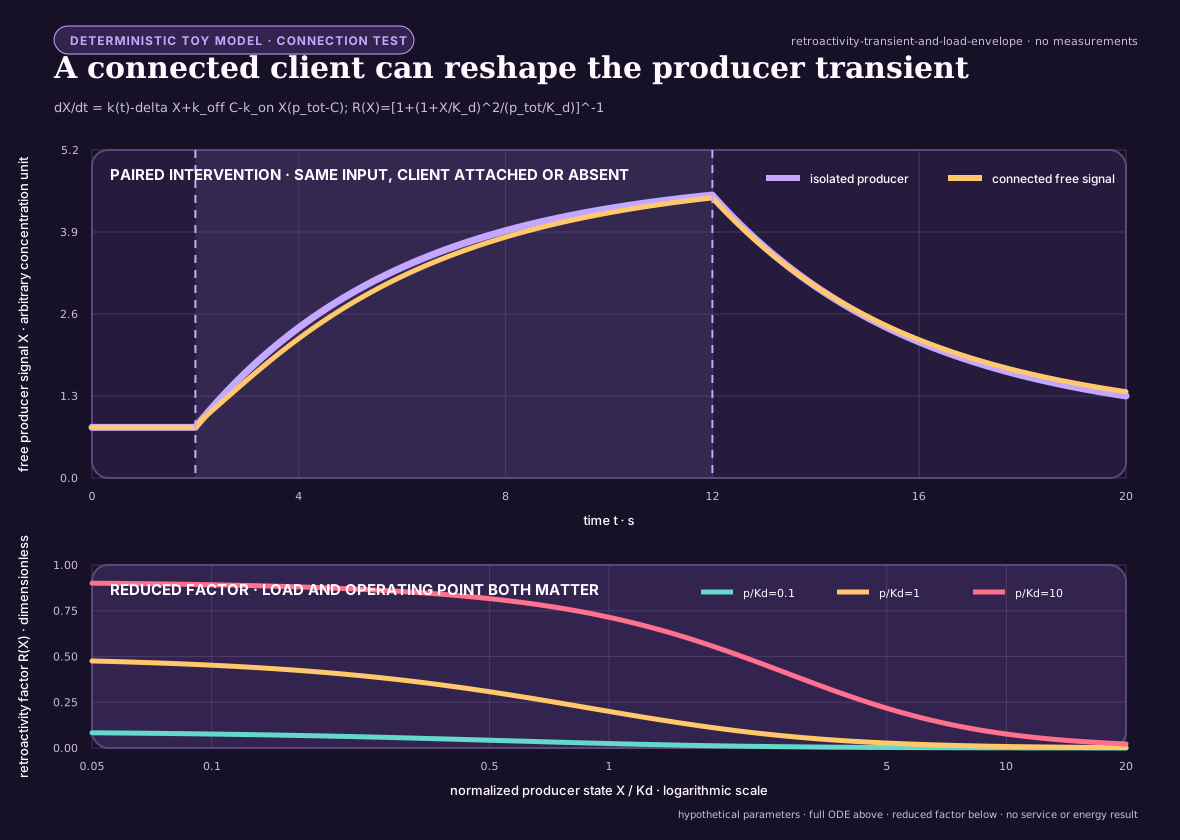
The figure is an explanatory rendering of the registered source equations, not an experiment result. Its editable definition is the core-model plot specification under the identifier interface-qualified-retroactivity; the generated SVG is kept beside the public site assets. Any parameter or caption change must begin in that editable specification and must retain the NO_RESULT boundary.
For client , let , , , , and have the corresponding units above. The full multiple-client model is
where is the dimensionless number of attached clients. Client effects need not be independent after they couple through the same free signal.
For heterogeneous fast-binding pools, define
Because and , the reduced free-signal model is
The empty sum gives ; for one client the expression reduces exactly to the single-pool factor above. It is licensed only when every registered fast- binding condition and the full-versus-reduced error gate pass. Replacing heterogeneous values by an averaged affinity is not this reduction.
Artificial bounded-publisher model
The AI translation is an interface test, not a claim that digital activations are molecules. It uses a stateful producer whose published states occupy a finite producer-owned slot until every direct consumer releases it.
| Symbol | Meaning | Unit |
|---|---|---|
| logical input-step index | dimensionless integer | |
| scheduled interval between input steps | s | |
| producer-state dimension | dimensionless count | |
| producer state at step | normalized state unit (NSU) | |
| registered producer input | normalized input unit (NIU) | |
| state transition from NSU to NSU | dimensionless | |
| input transition from NIU to NSU | NSU NIU | |
| output map from NSU to normalized output unit | NOU NSU | |
| producer output | normalized output unit (NOU) | |
| producer-owned publication slots | dimensionless count | |
| slots available at step | dimensionless count | |
| distinct publication-slot IDs with at least one unreleased client reference | dimensionless finite set | |
| registered hold time for client and publication | s | |
| pathway-specific downstream transform servers | dimensionless count | |
| transform-service demand for client at step | logical operation count | |
| finite substrate-service intervention indicator | dimensionless, zero or one | |
| direct output-sequestration intervention indicator | dimensionless, zero or one | |
| generic shared-resource intervention indicator | dimensionless, zero or one | |
| intentional-feedback intervention indicator | dimensionless, zero or one | |
| work for one snapshot copy | logical operation count | |
| bytes written for one snapshot | byte (B) | |
| deadline-lateness at step | s | |
| deadline-miss indicator | dimensionless, zero or one |
The isolated logical update is
Here is due at . Publication sequence semantically exposes the post-update state and derived scalar , carries as its due time, and records the update-completion time separately. The fixture's physical 96 B record serializes the state and metadata only; deriving requires the charged state reduction. A missing record leaves a permanent due-sequence gap; sequence IDs are not compacted or reused. State is an initial condition, not publication sequence zero. The non-published initial scalar is .
For the direct finite interface,
Multiple clients may hold the same publication slot; that slot appears once in . Summing client references would double-count a shared slot and is prohibited.
If a publication requires one slot, the frozen blocking rule is
The indicator equals one when its condition is true and zero otherwise. Holding the state is one registered policy. Drop-input, queue-input, and block-wall-clock policies are separate arms because they produce different trajectories.
An immutable-snapshot interface acquires the physical record, queues its charged copy into consumer-owned storage, and releases the producer slot only after copy completion, cancellation, or TTL expiry. Consumer work and consumer-storage lifetime cannot extend that source pin. The logical state transition may therefore retain a bounded copy-time effect under slot pressure; , , reference work, copy latency, queueing, staleness, and consumer-storage lifetime are all charged to the snapshot arm. The model exposes the benefit and cost rather than assuming free insulation.
Unless the fixture declares an override, snapshot, actor, backpressure, substrate-service, private-service, and replica arms reuse one capture law: capacity admission precedes source acquisition; an accepted 24 B descriptor reserves the 96 B destination; the producer worker acquires the exact source; and a charged per-client capture worker copies it before handoff to downstream service. Rejection creates no source reference, while cancellation releases the descriptor, reservation, any partial destination, and the source reference. These ownership intervals enter both and worker accounting.
Pathway-specific substrate-service control
The artificial substrate-competition control starts from identical immutable snapshot acquisition in its shared and private arms. Snapshot copying may pin the producer for its bounded copy interval, but transform service never owns or extends that reference; the contrast must therefore have zero producer- state effect even if both arms share the same copy-time effect. Every publication creates one transform request per subscribed client. The primary causal comparison fixes and uses identical 4096-operation-per-second servers in both arms. With , requests enter one deterministic FCFS queue feeding those servers. With , each client has one permanently assigned deterministic FCFS queue and one of the same servers. Both arms therefore have equal server count, per-server rate, nameplate capacity, and transform demand; only request pooling changes. Cells with are capacity diagnostics and cannot identify . Pooling can improve or worsen a client stratum, so the effect is two-sided.
This control represents competition for a declared domain-specific transform service, not a biochemical claim. Under exclusive producer placement its construction requires
for both values of . Thus finite transform service may change client outputs or latency, but it must not change logical producer state unless a separate path is enabled. A nonzero upstream distortion in that exclusive, immutable control falsifies the implementation boundary.
Causal identification
Let indicate direct output sequestration, let indicate finite pathway-specific substrate service, let indicate disconnected work-matched load on a generic shared resource, and let indicate the separately logged intentional feedback channel. For a dimensionless endpoint , write for the paired aggregate under the four binary settings. The baseline-referenced one-factor contrasts are
and
For example, the sequestration-by-shared-resource interaction is
All contrasts above are dimensionless because is dimensionless. Other pair and higher-order interactions use the same inclusion--exclusion rule and must be reported rather than absorbed into a main effect. Direct output back-action is identified only if survives exclusive resource allocation, collapses when the pinning path is cut, and cannot be reproduced by or . Substrate competition is identified through client-service changes under immutable producer reads that collapse when private transform servers replace the finite pool. Generic contention must be reproducible by disconnected work and must respond to resource placement. Intentional feedback is identified by replaying its logged messages with reads disabled and by disabling it while reads remain.
The disconnected load must match observed logical operations, bytes read, bytes written, allocation count, service-time distribution, and scheduling class as closely as the registered platform permits. Matching only nominal consumer count is insufficient. Equal total work does not identify substrate competition: requests must additionally be reassigned from the shared pathway-specific service to private services without changing snapshots or their demand.
Observation, noise-memory, and bandwidth estimators
Let be the output derived from the current producer state record, let be the latest completed client output, and let be buffered live version , all in normalized output units for replicate and sample . If is the dimensionless live-version count, the total-live observation is
This arithmetic mean is an artificial observation map, not a conserved biochemical total. It remains in normalized output units. Artificial publication records serialize eight state components and metadata, not a second output scalar. Each or therefore requires a 64 B state read and the fixture's charged eight-operation reduction. At each telemetry due time the distinct physical record set is frozen before asynchronous copying; duplicate client references do not duplicate a version, and logical expiry cannot turn a telemetry-pinned record into accepted service.
For observation map , let be the dimensionless replicate count, let be the dimensionless post-warm-up sample count, and let be the sample period in seconds. All replicates must share byte-identical input, hold, service, deadline, and fault histories; only the registered componentwise process-noise stream may differ. Let be the deterministic process-noise-disabled trajectory under those exact same events. The residual is
in normalized output units. Varying the input or any non-noise event across replicates invalidates the estimator rather than entering the residual. For the registered post-warm-up window, define the grand residual mean and centred residual
Both retain normalized output units. For dimensionless lag index , estimate the autocovariance
in squared normalized output units, and , which is dimensionless. Let be the first nonnegative lag at which two consecutive autocorrelations are nonpositive; if no such pair occurs before , the estimate is unavailable. The integrated correlation-time estimator is
in seconds. A nonpositive estimate, a nonstationary residual diagnostic, or missing observation events invalidates the estimate rather than triggering imputation.
The fixture's executable nonstationarity diagnostic divides the complete post-warm-up residual sequence into ten contiguous equal-count blocks. With block mean , population variance , grand mean , and , it reports
is available only when NOU, , every block is complete, and no observation is missing. These are fixture decisions, not universal stationarity criteria; the registered sensitivity thresholds are reported.
For an input sinusoid of angular frequency in radians per second, where is in hertz, fit the post-warm-up output
where , , , and residual have the output unit and is in seconds. If the fitted input amplitude is in normalized input units, output amplitude has the output unit and gain has output units per input unit. Phase is in radians. The DC probe uses two constant inputs around NIU, NIU and NIU, with the explicit shared override NSU for every component, plus the same event history and observation map. If and are their final-50-second means after a 300 s run, define
This is the fixture's operational DC estimate; failure of either constant trajectory to converge makes it unavailable. The minus-three-decibel bandwidth is the smallest interpolated frequency
in radians per second. Log-linear interpolation is allowed only between two adjacent excited frequencies bracketing the threshold; otherwise is unavailable.
Distortion, competition, and service endpoints
Let be a registered evaluation duration in seconds, an upstream output in a declared output unit, and a frozen scale in the same unit. The upstream trajectory distortion is
is dimensionless. Its discrete, duration-weighted implementation is
where is the dimensionless sample count and is the duration represented by sample , in seconds.
For the artificial fixture, samples are always taken on the exogenous due grid . The value at is the latest producer state whose service completed by , held from its actual completion, or if none has completed. Blocked and queued updates are not realigned by logical sequence. The same sample-and-hold trace defines , , and ; client latency remains completion time minus the original due time.
For an existing downstream client, let and be the integrity-valid outputs for exact sequence completed by its fixed deadline in the -client and paired one-client arms. Let and be their zero-or-one availability indicators, let be the frozen output scale, and let be the fixture's dimensionless missing penalty. Define
The endpoint is dimensionless, retains every due sequence, and separates harm to an existing client from distortion of the producer. Complete-case values are diagnostic only; sensitivity uses .
For a registered step whose output changes from to , and for , define
and are therefore the and cases and are in seconds. Upward and downward values are reported separately; their difference is not called sign-sensitive unless the input, initial state, endpoint, and observation map are registered.
If outputs are due and meet the frozen accuracy and deadline criteria, accepted service is
a dimensionless fraction. Dropped, stale, duplicated, late, and inaccurate outputs remain separate counts before any accepted-service aggregation.
For latency, every due output contributes one value. An integrity-valid completion contributes completion time minus original due time; any dropped, stale, duplicated, integrity-failed, or unavailable output contributes the right-censor value s. The ordinary nearest-rank p99 is reported. The protected used below equals if any censored value exists, and otherwise equals that ordinary p99. A valid-completion-only quantile is diagnostic only.
Insulation and weak-coupling frontiers
An insulating interface is evaluated on a vector, not a scalar:
Here is p99 latency in seconds, is logical operation count, is peak retained memory in bytes, is total bytes written, and is provisioned reference-worker time, and is peak concurrent worker count, a dimensionless count. For worker at rate logical operations per second and provisioned duration ,
The same ledger reports active and idle reference-worker seconds. Including in the mandatory vector prevents an arm from treating extra parallel workers or a higher service-rate multiplier as free merely because its operation count is unchanged. is measured energy in joules. Until calibrated workstation measurement exists, is unavailable and cannot be replaced by or .
One arm dominates another only if it is no worse on every registered endpoint and strictly better on at least one, with uncertainty and relevance margins applied as frozen in the experiment contract.
Let be a dimensionless coupling-strength multiplier, let be dimensionless upstream distortion, let be dimensionless tracking error at angular frequency in radians per second, and let be dimensionless error when each scheduled direct-reference release independently fails with dimensionless probability . If a continuous-time comparison is needed at constant scheduled reference-release rate in s, the corresponding hazard is
which is approximately only for small . A low-coupling regime can satisfy
while simultaneously satisfying
Thus reducing back-action can worsen bandwidth or leak robustness. No universal monotone energy law follows from the coupling label.
Deliberate temporal-use comparator
Fixture F-027's RIN-T10 asks whether a declared back-action should be suppressed, preserved, or used for a temporal objective. Let s be the target time constant and define the dimensionless coefficient
For isolated output in NOU, the causal target state is
Here is the post-update isolated publication for due sequence . Sequence uses the already-existing ; only after emission may the recurrence consume to form . The state is initialized once and is not reset when clients detach at 150 s. The active scored reference is
For ordinary client , let be its exact set of due sequences while active, let , let be its delivered target sample, and let indicate that the sample is available, timely, current, and integrity-valid. With the registered missing penalty , define
and
The primary target endpoint is
Client 1 and the pooled active-client RMSE are separate reports; neither can replace the maximum in the primary gate.
Sensitivity substitutes 2 and 100 NOU for ; invalid samples never leave the denominator.
The explicit-filter null emits its current state before applying a recurrence. Let be the number of due sequences before the switch and let be the number of useful next-state recurrences. The fixture's scalar-allocation and read/write law gives these nominal filter- specific totals for a complete chain:
The physical ingress stores eight state components, not . Deriving that scalar reads 64 B and costs seven additions plus one multiplication. The displayed operation total expands to coefficient setup, the sequence-zero derivation and state initialization, emissions, recurrence cores, later input derivations, and final release. The constant 48 B written is the associated coefficient, state, allocator, and release ledger. Filter-specific peak live storage is 24 B: coefficient, state, and transient output. Missing ingress changes actual counts and is reconstructed from raw events; the nominal formulas cannot be applied to a broken chain. One fixed- TTL B-SNAPSHOT ingress is additional. Every successful pre-switch emission also creates one filter-owned typed 96 B source on the FCFS filter worker, paying the common allocation, initialization, transient-read, reference-acquisition, and eventual release charges. Its per-client descriptors pin that source until copy completion, cancellation, or source TTL; every destination then pays the ordinary B-SNAPSHOT allocation, copy, reference-release, destination-release, queue, and client-service charges. The filter worker serially executes coefficient setup, input derivation, emission, source creation, descriptor acquisition, and recurrence work, so these counts determine timing. From 225 s the arm cancels remaining pre-switch sources and copies, bypasses the recurrence and uses the ordinary immutable isolated-output route while retaining coefficient and state until episode end.
Numerical and dimensional checks
- Every term in each differential equation must have the dependent variable's unit per second.
- and are invariants of valid biological-source simulations with nonnegative initial states and nonnegative production.
- The binding-only contribution conserves to the registered solver tolerance.
- The reduced formula is tested only against the full model; it is never its own oracle.
- State and client trajectories are integrated on the same time grid before a paired discrepancy is evaluated.
- Fixed-step convergence is checked against half-step and quarter-step solutions or an independently configured adaptive solver.
- Event ties in the artificial system use this frozen order: expire snapshot TTLs and normally scheduled direct references; apply detachments and joins; complete copies; complete consumer/transform service and create valid feedback messages; complete and deliver feedback service; complete and route C-ADAPT decisions; record crash, restart, or version change; deliver input; update the producer and apply already delivered feedback; publish, execute the block/drop/queue rule, or enqueue a controller request; acquire an immediately routed publication; enqueue telemetry; score deadlines; append the event record.
- A count, byte, second, joule, and watt are never added without an explicit objective and dimensional conversion.
Validity and kill boundaries
- A read of immutable state with abundant independent storage may have no direct output back-action. In that regime, the sequestration translation must collapse.
- Competition among declared downstream transformations is not inferred from generic CPU delay; it requires a pathway-specific finite-service intervention.
- General CPU, memory, transcription, or translation contention is not relabelled direct sequestration or substrate competition.
- A coupling that improves a declared integration objective is not insulated automatically. Its benefit and harm must be evaluated under an ablation that preserves input information and total work.
- Intended gradients, acknowledgements, feedforward controllers, or supervisory control remain declared useful coupling.
- A reporter or monitor can itself be a downstream client; an observation is not assumed non-invasive.
- A lower is not useful if client service, task accuracy, latency, memory, recovery, or complete lifecycle work becomes unacceptable.
- Static equality does not imply dynamic modularity. Step, pulse, periodic, burst, and stochastic histories remain separate.
- The source model does not establish that phosphorylation cycles evolved to insulate, or that the same mechanism exists in artificial systems.
- The fixture is retired as an architecture contribution if ordinary snapshots, queues, backpressure, process isolation, admission control, or resource reservation match the complete frontier.
- Logical operations and bytes are resource measures, not joules.
- Every equation and experiment in this note remains NO_RESULT until a registered execution produces a valid artifact.