Experience should change behavior immediately without receiving immediate permission to rewrite stable capability.
Scope
Memory is a lifecycle: capture an event, preserve its origin, decide whether it deserves more work, test an integration, then retain, transform, externalize, weaken, or delete it. The objective is rapid adaptation without granting every surprising event permission to rewrite stable capability.
One memory lifecycle
flowchart TB
    subgraph capture["1 · Capture with provenance"]
        direction LR
        event["Event + outcome"] --> episode["Attributable episode"]
        episode --> score["Value · conflict · cost · risk"]
    end
    subgraph maintain["2 · Choose a reversible action"]
        direction LR
        action{"Maintenance action"} --> branch["Replay / merge branch"]
        action --> factual["Externalize fact"]
        action --> retire["Defer · weaken · delete"]
    end
    subgraph promote["3 · Prove before promotion"]
        direction LR
        tests["Retention · adaptation · energy tests"] --> result{"Pass?"}
        result -->|"yes"| durable["Durable skill / slow model"]
        result -->|"no"| retained["Keep episode; reject update"]
    end
    score --> action
    branch --> tests
    factual --> runtime["Future runtime"]
    durable --> runtime
    retire --> record["Provenance / tombstone"]
The lifecycle separates two decisions often collapsed into “learning”:
- What should be remembered now? Capture is fast, attributable, and reversible.
- What should change the durable system? Consolidation is selective, tested, and budgeted.
Biological observation
Complementary Learning Systems theory describes interacting fast hippocampal and slower cortical learning processes (C-008). The useful pattern is not only different storage speeds. It is controlled transfer between a rapidly changing record of experience and structure whose value depends on remaining stable.
The evidence also makes replay a selection problem:
- disrupting replay from a selected hippocampal assembly can selectively impair the associated rodent spatial memory (C-036);
- replay allocation varies with reward, learning, familiarity, and memory weakness rather than following one universal priority (C-037);
- existing relational structure can accelerate integration of compatible associations (C-038);
- retrieval can make an established memory temporarily update-sensitive (C-039), although the exact human prediction-error gate remains disputed (C-040); and
- forgetting can be actively regulated by neural and glial mechanisms in specific preparations (C-041, C-042).
Together they motivate a maintenance controller that allocates limited work across capture, replay, integration, protection, and forgetting.
Proposed AI translation
1. Separate stores by write authority
| Store | Update rate | Content | Normal mutation |
|---|---|---|---|
| Working state | every event | active context, goals, predictions | overwritten freely |
| Episodic store | rapid | sourced trajectories, outcomes, errors | append, expire, redact |
| Slow model | controlled | reusable representations and skills | validated consolidation |
| Factual store | independent | mutable, attributable propositions | explicit versioned update |
The separation is about authority, not hardware. A vector store, database, recurrent state, adapter, and model weights may share a device while obeying different write policies. One logical store may also span devices when locality or retention requires it.
Memory mode, lifetime, and retrieval are separate axes
Plant systems expose useful counterexamples to treating every durable effect as one scalar “memory strength.” In Arabidopsis vernalization, a quantitative whole-organism response can arise from the fraction of loci or cells in a binary state rather than an analogue value stored in every unit (C-1516). The same state can persist through somatic growth yet be actively reset at a lifecycle boundary (C-1517). In heat-stress memory, the acute writer, persistent trace, and later reinduction are causally separable (C-1518). Regenerative preparedness can also be localized while its required reserve remains an explicit cost (C-1519).
An artificial memory record therefore declares at least five independent fields:
| Field | Question | Required comparison |
|---|---|---|
| representation | analogue value, discrete state, population fraction, trace, or external record? | equal-state filter, quantizer, latch population, cache, or database |
| write event | which observation and authority create or revise it? | always-write, threshold, change-point, and versioned branch |
| maintenance lifetime | what keeps the state valid, and for how long? | TTL, decay, replay, checkpoint, and explicit refresh |
| retrieval gate | which recurrence, query, or context lets it influence action? | recurrent state, keyed retrieval, and calibrated classifier |
| reset boundary | which evidence authorizes weakening, deletion, or reinitialization? | no reset, fixed reset, evidence-gated reset, and ordinary adaptation |
A relative-sensing reference is one concrete instance of this lifecycle. In the cited EGF/HGF system, background-dependent surface-receptor abundance is consistent with a ligand-specific stored reference, while production, delivery, turnover and recovery maintain it (C-1548). The artificial translation therefore stores channel identity, reference value, age, support, writer, reset and maintenance cost together. A current ratio without those fields is not a complete memory record.
This reference state competes directly with an exponential moving average, state-space estimator and compact recurrent state. It survives only when its channel specificity and task value remain after missing observations, cross-channel stimulation, stale state, forced reset and accelerated turnover, and after every reference write and fallback is charged. The lifecycle track is RSD-T09.
Hysteresis is state, not reset authority
A minimal binary hysteretic state makes the history dependence explicit. For dimensionless input , retained state , and ordered thresholds ,
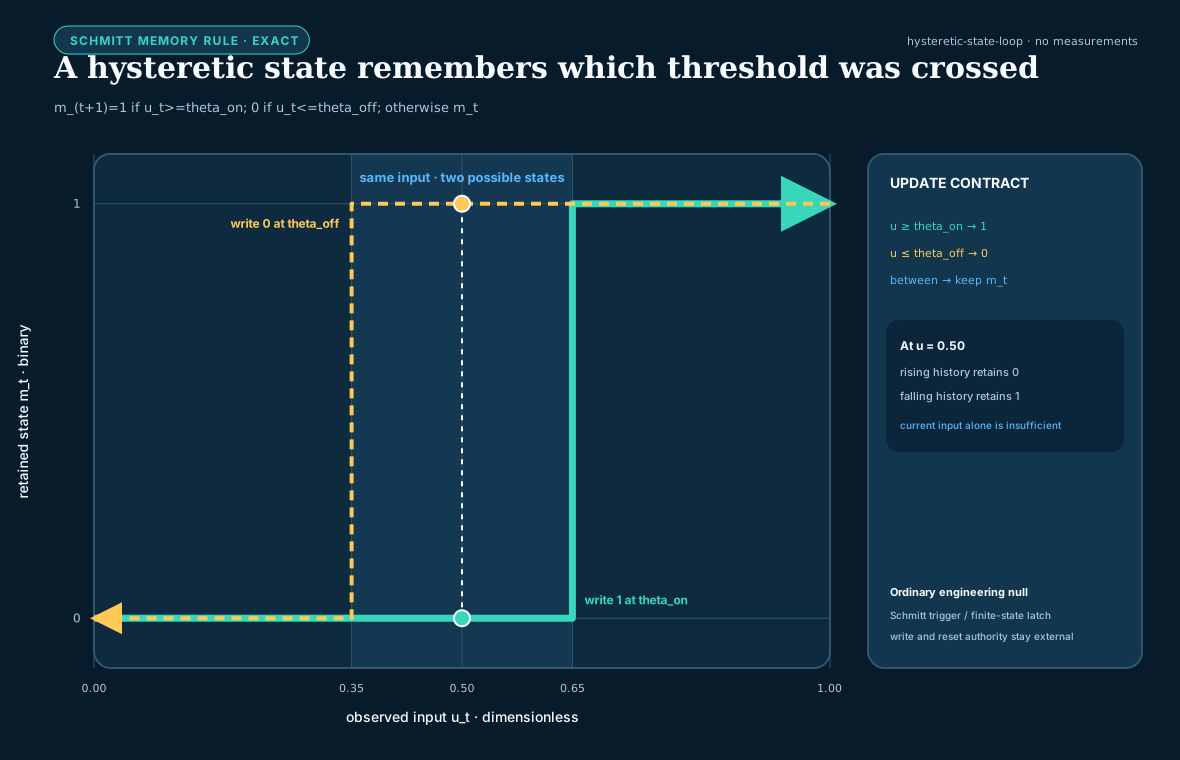
Inside the band, alone does not identify ; the prior state is a necessary input. This is useful precisely because it supplies a strong ordinary null: a proposed population memory must beat a Schmitt trigger, quantized accumulator, or finite-state latch under equal state, random-number, write, reset, and error budgets. The rule also keeps two questions separate. It defines how state persists, but it does not decide which authenticated event is allowed to reset that state at a lifecycle boundary.
History dependence also enters through acquisition order. Different final performance after the same set of tasks can reflect unequal age or exposure, ordinary catastrophic interference, curriculum selection, finite-capacity pre-emption, shared-state modification, facilitation, or irreversible lock-in. These are not interchangeable explanations. The history-conditioned modular-succession audit requires the same task multiset and eligible module identity set, exogenous presentations and task-local update ceilings, plus matched capacity, optimizer, evaluator and lifecycle budgets before estimating an order effect. Realized module lifecycle state remains an outcome. Endogenous routed acceptance is measured and equalized only in the exposure-cut cells. Its mathematical contract then crosses the candidate carriers as randomized interventions and kills the translation when canonical replay, scheduling, replay/EWC/OGD, or a search-budget-charged curriculum is non-inferior.
Two electrochemical results sharpen the test. First, eliminating a distributed diffusion field can yield a memory kernel whose apparent power law changes when a finite boundary becomes visible; the memory horizon is therefore a property of the support and observation band, not a free architectural constant (C-1531). Second, insertion systems can expose the same scalar occupancy with different terminal responses because the particle population followed different paths (C-1538). A single direction bit, finite-state latch, compact recurrent state, and balanced state-space realization are the required nulls before retaining a larger history or population state.
For a linear diffusion field on length , the characteristic time
has units of seconds because is measured in metres and the diffusion coefficient in square metres per second. A proposed memory window shorter than the supported fraction of must reveal its truncation error; a window much longer than required must pay for retained state and movement. The full ECM-T02 and ECM-T09 contracts test both cases without assuming that an electrochemical kernel is the best software realization.
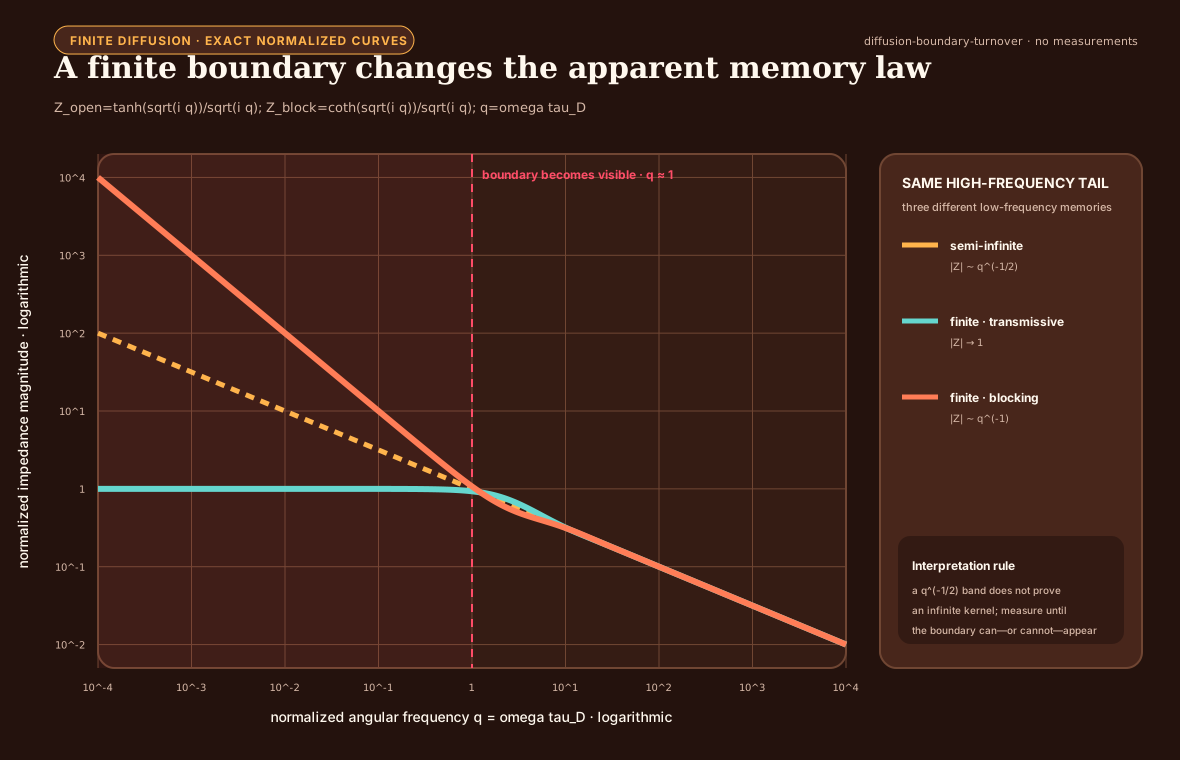
With , the plotted normalized finite-boundary forms are and . Their magnitudes approach different low-frequency limits even though both can resemble the semi-infinite law over a higher-frequency band. The visible turnover is why a fitted fractional-looking kernel cannot establish infinite memory by itself.
These fields expose three shortcuts to review: encoding duration with unjustified precision, calling incidental decay a designed reset, and treating trace correlation as the sole memory carrier. They also make reserve bytes, random state, calibration, refresh, reset, false retrieval, and recovery visible in the lifecycle ledger.
Plant signalling adds a second constraint: remembered state and current context may arrive on different routes. A cheap common alarm can require typed context before action (C-1520); route identity can be conditionally informative but must survive tag, capacity, maintenance, and common-mode accounting (C-1521). Active growth can create the evidence that gates later structural commitment (C-1522), while current exportable resource can condition future interface density only after its developmental delay and confounders are tested (C-1523). Boundary sensing plus a routed event wave remains a plausible composition, not an automatic advantage (C-1524), and a coupled light/temperature/history sensor is useful only inside an identifiable calibration envelope (C-1525).
Fixture F-023
turns these distinctions into ten preimplementation tests. It currently has
NO_RESULT; no biology-derived efficiency factor is assumed.
2. Capture evidence before abstracting it
Each episode records enough context to explain a later update:
- observation and relevant prior state;
- action, answer, or intervention;
- outcome and uncertainty;
- data and tool provenance;
- active modules and retrieved memories;
- physical telemetry; and
- privacy, retention, and safety constraints.
The episode need not contain every hidden activation. It must preserve enough attributable evidence to reproduce, challenge, or reverse the lesson later derived from it.
3. Allocate the maintenance budget
At a maintenance window, the controller estimates what each candidate action could improve and what it would cost. Novelty, reward, uncertainty, familiarity, conflict, interference, and schema fit are features—not interchangeable definitions of importance.
The first controller should earn its complexity against ordinary policies:
- uniform reservoir replay;
- recency;
- loss- or TD-error priority;
- interference priority;
- schema-fit priority; and
- the proposed multi-signal lifecycle policy.
Every method receives the same episode bytes, replay examples, optimizer updates, wall time, and energy boundary. This makes scheduling policy—not extra maintenance—the independent variable.
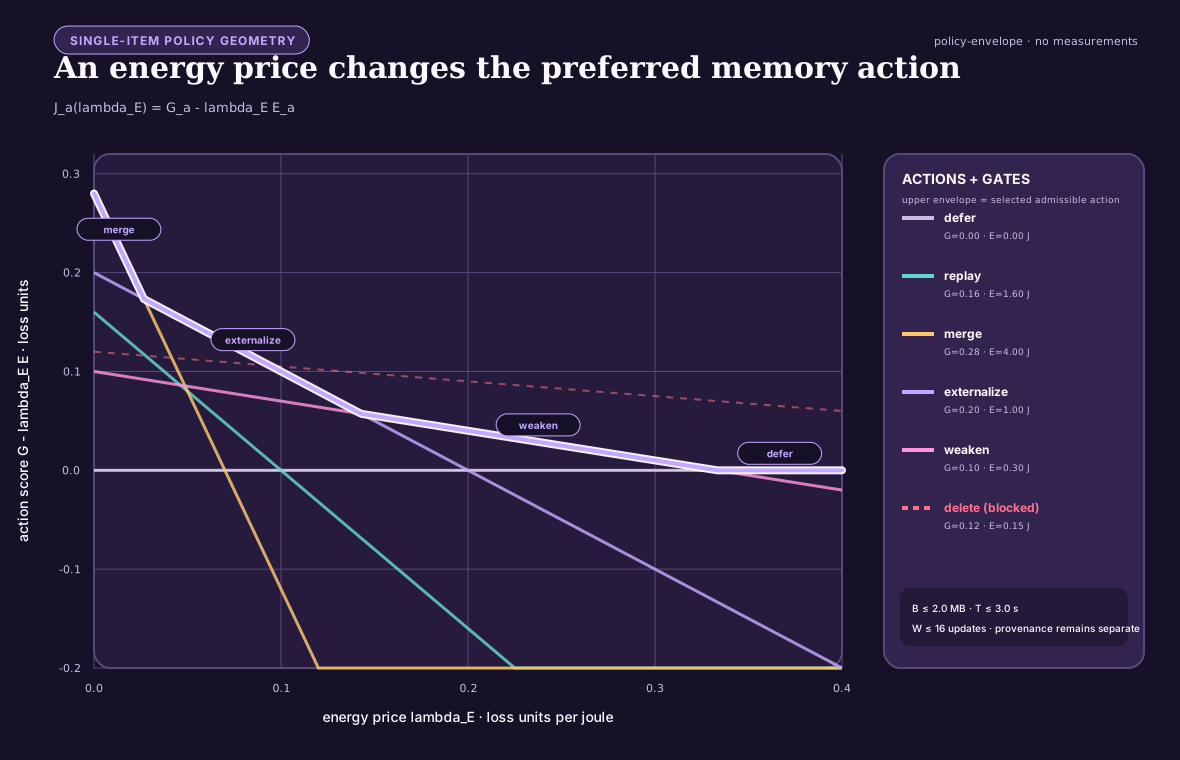
The following single-item price envelope uses hypothetical gains and costs to make the selection equation visible. It is not a fitted scheduler or an empirical ranking of the listed actions.
4. Branch, test, then promote
Retrieval or replay opens a versioned candidate branch. It never makes the durable state writable by itself. The branch may modify a local adapter, module, route, representation, or factual record and is then tested for:
- retention of protected historical capability;
- acquisition of the proposed new capability;
- calibration and rare-case behavior;
- provenance and conflict handling;
- measured energy, bytes moved, and latency; and
- reversibility after rejection.
Replay and Elastic Weight Consolidation are distinct comparison mechanisms (C-009, C-010); neither is privileged as the final protection policy.
A passed branch can merge into the slow model, remain provisional, or enter the maturity and structural-consolidation lifecycle. A failed branch returns the episode with its negative result attached so the same invalid integration is not proposed indefinitely.
5. Forgetting is an action
Unbounded retention consumes storage, retrieval bandwidth, replay capacity, and attention. The controller therefore distinguishes:
| Action | Effect | Required safeguard |
|---|---|---|
| Defer | preserve without more work | future reconsideration rule |
| Replay | spend work to test or strengthen | equal replay budget |
| Merge | compress compatible state | provenance survives compression |
| Externalize | move mutable information out of weights | source and version retained |
| Weaken | reduce retrieval or routing influence | rare-case regression probes |
| Delete | remove active state | reconstructable source or explicit retention exception |
Weakening is separate from deletion because many obsolete or interfering memories should first lose influence while evidence accumulates. A tombstone or provenance record prevents deleted state from becoming an unexplained absence.
Storage contracts precede memory policy
Persistent state has several independent contracts:
| Contract | Question | Does not establish |
|---|---|---|
| atomicity and recovery | which in-scope effects commit or abort after failure? | isolation, outside-effect reversal, or truth |
| isolation | which concurrent histories are visible? | real-time order or durability |
| durability | what survives acknowledged completion under the fault model? | correctness or indefinite retention |
| version visibility | which snapshot or temporal coordinate answers a read? | serializability or current-world truth |
| replication/coding | which exact bytes or log survive named faults? | independent judgment or semantic diversity |
| indexing/caching | where is a candidate copy found cheaply? | importance, authority, or source-of-truth status |
| retention/reclamation | which roots, readers, holds, and horizons keep state live? | future irrelevance or epistemic worth |
These boundaries are established by storage theory and systems evidence in C-325–C-338. Versioning alone does not make a history serializable; a durable statement can remain false; an agreed log can preserve a bad command; and event replay can change meaning when handlers, schemas, configuration, nondeterministic inputs, or outside effects are not version-compatible.
Valid time and system time remain separate. The first records when a proposition is asserted to hold in the modeled world; the second records when the store held that version (C-337). Capture, receipt, processing, correction, and supersession may add more clocks.
Semantic compaction has a finite preservation contract
Physical compaction preserves a declared storage view; it is not automatically semantic consolidation (C-334, C-341). A semantic compactor may replace history with only under registered query, evidence, uncertainty, rollback, invalidation, deletion, and failure-degradation obligations.
Candidate contract diagram: Semantic compaction contract diagram.
Candidate 017 freezes the compactor before generating hidden future queries and invalidation requests. It compares with indexed history, snapshots plus suffix logs, materialized views, key compaction, lossless compression, extractive evidence summaries, and cold archives. Unsupported questions must be exposed, not filled with invented detail.
Placement separates access, value, and reconstructability
Recency and frequency are strong baselines, not definitions of importance (C-333). A rare cold artifact may still block a safety audit, source invalidation, rollback, or recovery. Conversely, a hot derived view may be cheap to reconstruct. The placement controller therefore keeps access forecast, recomputation cost, task loss, evidence value, staleness, and correlated-failure reconstructability as separately calibrated quantities.
Candidate contract diagram: Value-aware artifact tiering diagram.
Candidate 018 must beat LRU/LFU, ARC, W-TinyLFU, size- and miss-cost-aware caching, economic tiering, static optimization, and coded fault-domain placement without future labels. Physical bytes, movement, metadata, endurance, p99 latency, policy work, privacy, and failure costs remain inside the boundary.
Learning is a horizon-indexed outcome vector
Immediate task success does not identify durable learning. A curriculum event can improve acquisition while weakening delayed retention, novel transfer, fluency, calibration, motivation, or total efficiency. The evaluator therefore keeps those outputs separate and makes retention horizon and transfer distance part of the claim. The evidence boundaries are C-627–C-658.
flowchart LR
    G["Skill goal + retention / transfer horizon"] --> S["Skill-local learner state"]
    S --> P["Select retrieval · example · spacing · variation · support"]
    P --> A["Attempt before answer / scaffold"]
    A --> O["Outcome · latency · confidence · help · cost"]
    O --> E["Immediate acquisition evaluator"]
    O --> R["Delayed retention evaluator"]
    O --> T["Preregistered transfer strata"]
    O --> F["Fluency · calibration · motivation"]
    E --> U{"Update support / schedule?"}
    R --> U
    T --> U
    F --> U
    U --> S
    U --> X["Fade · retain · branch · stop"]
    C["Teacher + learner + compute + energy cost"] -.-> P
    C -.-> U
For each skill, retain current acquisition estimate, retention estimates at declared horizons, transfer by preregistered stratum, fluency/error frontier, calibration, support/scaffold state, confusability/context, intervention history, state version, and uncertainty. Difficulty is useful only when the attempt is processed successfully enough to generate information; failure is not beneficial merely because it was hard.
Candidate 004 must compare the adaptive sequence with tuned spacing, ordinary knowledge tracing, fixed fading, hard-example mining, and fixed curricula at equal attempt, feedback, time, storage, compute, and energy. Candidate 019 must compare interactive teaching with a versioned artifact plus tests, then measure retention and novel transfer after actual learner/model turnover while charging both teacher and learner effort. The learning-outcome mathematics defines the common evaluator.
6. Follow one event through the lifecycle
Suppose a tool returns a surprising result. Working state can use it immediately, while an attributable episode preserves the action, outcome, uncertainty, source, and active path. The slow model does not change yet. Related and conflicting outcomes accumulate until a maintenance window judges the episode worth replaying. Replay opens a local branch and tests it against protected history.
What happens next depends on the content. A reusable operation may become a skill or provisional module. A mutable proposition belongs in factual memory. Noise loses influence or expires under the retention policy. Later outcomes measure whether that choice was correct and recalibrate the scheduler. This is the feedback that turns a storage hierarchy into a lifecycle.
Efficiency mechanism
Online operation avoids immediate full-model gradient updates. Maintenance spends that work later and selectively, where expected future value justifies the physical cost.
For events between maintenance windows, amortized energy per served event is
where is runtime energy per event in joules and includes scheduler, replay, memory movement, optimization, validation, and recovery energy in joules. A system saves energy only when the second term remains below the online work avoided by delayed and selective integration.
The full constrained action model—including joule, byte, second, and optimizer
update budgets—is defined in
../math/memory-lifecycle.md.
Evidence status
| Mechanism | Evidence | Current status |
|---|---|---|
| Fast/slow learning split | C-008 | established theory and supporting results; system translation incomplete |
| Interference protection | C-009 | demonstrated in scoped sequential tasks |
| Replay for machine consolidation | C-010 | plausible mechanism with task-specific evidence |
| Content-specific replay | C-036 | established in the measured rodent intervention |
| Multi-signal replay allocation | C-037 | established constituent observations; unified policy experimental |
| Schema-sensitive integration | C-038 | established in scoped learning conditions |
| Retrieval-induced update window | C-039, C-040 | lability established narrowly; exact human mismatch gate disputed |
| Active forgetting | C-041, C-042 | established in scoped interventions; safe AI policy untested |
| Storage and temporal contracts | C-325–C-338 | mature engineered mechanisms; mandatory nulls and vocabulary |
| Semantic compaction and value-aware tiering | C-339–C-342 | held residual experiments under Candidates 017 and 018 |
| Complete lifecycle controller | none | speculative synthesis |
Speculative extensions
- Generate counterfactual variants around high-value episodes rather than only replaying recorded inputs.
- Learn expected knowledge gain per joule while retaining hard resource and safety bounds.
- Perform module-local consolidation first and synchronize globally only when a cross-module invariant changes.
- Use exact checkpoints to test several consolidation outcomes in parallel and retain the cheapest one that passes.
- Learn memory placement jointly with replay policy so frequently paired state becomes physically local.
Failure modes
- Replay amplifies biased, adversarial, or privacy-sensitive episodes.
- The scheduler starves quiet, rare, or safety-critical memories.
- A correlated shortcut is mistaken for schema compatibility.
- Generated replay drifts away from the environment.
- Retrieval becomes an adversarial write primitive.
- Weakening or deletion removes evidence later required for recovery or audit.
- A compact summary passes familiar queries but loses evidence, invalidation, rollback, deletion, or rare hidden-future obligations.
- A placement policy calls access frequency “importance,” leaks future value, or treats correlated replicas as independently reconstructible.
- Scheduler scans and telemetry consume the saved maintenance budget.
- The episodic store becomes an unbounded duplicate of the training corpus.
Measurable predictions
- Fast attributable memory reduces adaptation latency without increasing protected slow-model regression.
- A multi-signal scheduler improves the retention–adaptation–energy frontier beyond uniform, recency, loss-priority, and interference-priority baselines at equal replay count and bytes moved.
- Schema-compatible episodes require fewer optimizer updates to integrate than violations while shortcut-controlled transfer remains unchanged or improves.
- Explicit weakening reduces obsolete-memory intrusions without exceeding the declared rare-case deletion bound.
- Separating mutable propositions from reusable skills reduces correction cost and unsupported factual carryover.
- Maintenance energy amortized per served event remains below the online training work it replaces.
- Registered semantic compaction reduces physical bytes without reducing hidden-query, evidence, rollback, or invalidation coverage below threshold.
- Value/reconstructability features improve shifted-workload artifact placement beyond strong cache and storage policies after migration cost.