Scope
Define how a useful but plastic structure becomes protected, cheaper to run, and eventually eligible for pruning—without mistaking age, low training loss, or a grokking curve for proof of maturity.
Maturity is a lifecycle state, not a compliment. A mature module has earned a narrower update surface because its behavior is understood inside a declared validation envelope. That protection must remain reversible when the envelope changes or the module becomes brittle.
Biological observation
Development does not produce a final circuit by training every connection at a constant rate forever. In the studied mouse retinogeniculate preparation, relative activity and complement signaling affected microglial engulfment and retention of developing inputs (C-043). The useful abstraction is a slow maintenance process that helps refine structure under local evidence; it is not a universal deletion rule.
Mature circuits can also carry local constraints on further change. Targeted interventions on extracellular structure and a cholinergic brake reopened specific forms of adult visual-cortex plasticity (C-044, C-045). Protection and plasticity are therefore not opposite endpoints. They can be different operating states of the same structure, controlled locally and revisited under an explicit intervention.
Two results from ecological systems sharpen the control problem. Recovery from small perturbations slowed as one cyanobacterial microcosm approached a controlled tipping point (C-058); warning statistics also appeared during a manipulated whole-lake food-web transition (C-059). A system may look acceptable at rest while its restoring dynamics weaken. Maturity therefore cannot be certified by steady-state accuracy alone.
Nor is resilience one number. Greater species richness improved temporal stability but reduced resistance to warming in a large ciliate-microcosm experiment (C-060). In a separate microbiome analysis, functional redundancy was associated with resistance to newcomer engraftment (C-057). Stability, resistance, recovery, and capacity to admit a better replacement can move in different directions.
This makes grokking a useful phenomenon but a poor gate. Delayed generalization has been observed in bounded algorithmic settings, yet the claim that extended training reliably reveals the underlying rule and certifies readiness to prune is disputed (C-011). The system needs evidence about what a structure does, how uniquely it contributes, how it fails, and how it recovers.
Proposed AI translation
A reversible maturity lifecycle
Every structurally changeable module, route, memory transform, or compiled path has an explicit lifecycle state:
- Candidate: highly plastic, attributable to its training episodes, and cheap to discard.
- Consolidating: replayed against related, conflicting, rare, and intervention cases while its unique contribution is measured.
- Protected: update rate and writable surface are reduced; structural changes require a versioned branch and shadow evaluation.
- Reopened: a copy-on-write branch receives bounded adaptation while the protected version remains available for comparison and rollback.
- Retiring: traffic is drained only after another path covers the required behavior and the physical execution graph can actually be compacted.
- Archived or removed: provenance, validation envelope, and a reconstructable checkpoint remain for the declared retention period; hot execution state is released.
flowchart TB
    subgraph establish["1 · Establish maturity"]
        direction LR
        candidate["Plastic candidate"] --> evidence["Evidence gate"]
        evidence --> consolidate["Consolidate + shadow-test"]
        consolidate --> protected["Protected capability"]
    end
    protected --> health{"2 · Health and utility"}
    subgraph respond["3 · Choose the reversible response"]
        direction LR
        reopen["Fragile → reopen and re-test"]
        retain["Healthy → retain protection"]
        archive["Redundant + recoverable → archive"]
    end
    health --> reopen
    health --> retain
    health --> archive
The lifecycle separates three decisions often collapsed into “pruning”:
- protect: this path is useful and should stop drifting;
- reopen: this path no longer responds adequately inside its required envelope; and
- retire: this path is no longer uniquely useful and can be removed without making the system irrecoverable.
Protection is not retirement. A path may be mature precisely because it is important enough to preserve.
Maturity is a vector gate
For module , maintain a maturity record
where:
- is quality across the declared validation envelope;
- is unique causal contribution under ablation and rerouting;
- is behavioral and routing stability across time and environments;
- is fragility measured from recovery and margin estimates;
- is adaptation and newcomer-acceptance behavior under controlled shift;
- is full-lifecycle physical cost; and
- is provenance and rollback completeness.
The record remains a vector. A weighted score may rank candidates for review, but it cannot hide a failed safety, provenance, recovery, or rollback constraint. Thresholds are workload-specific and include uncertainty intervals; there is no universal maturity age, pruning percentage, or recovery constant.
Protection requires evidence that the module is useful, stable, attributable, and recoverable. Retirement reverses one condition: its unique contribution must be low because another tested path covers its role. Low weight magnitude or low average routing frequency is not enough.
Structural consolidation before deletion
When several routes repeatedly implement the same stable computation, the maintenance plane first tries to make their shared work explicit:
- identify the recurrent subgraph and its boundary contract;
- build a compact candidate through structured pruning, distillation, compilation, quantization, fusion, or relocation;
- replay both common and conflicting cases through old and new graphs;
- intervene on each source module to measure residual unique behavior;
- shadow the compact path under live-like traffic;
- drain old routes gradually while keeping rollback state; and
- release tensors, optimizer state, routing entries, and communication only after the observation window passes.
Iterative pruning can reveal competitive sparse subnetworks in its tested settings (C-012). Here it is one operator inside the lifecycle, not the lifecycle policy itself. Magnitude pruning is a baseline; causal coverage and end-to-end physical savings decide promotion.
Reopening without overwriting the canonical path
A protected path is reopened only after a persistent signal, such as:
- calibrated error or intervention failure outside its historical variance;
- recurring novelty that existing candidates cannot absorb without interference;
- loss of recovery margin despite acceptable steady-state quality;
- repeated rollback or escalation around the same boundary; or
- evidence that protected redundancy prevents a superior newcomer from receiving a fair evaluation.
Reopening creates a branch. It does not make the canonical path globally writable. The branch receives a declared update, data, compute, and duration budget; the protected version continues on control traffic. The branch becomes canonical only after retention, calibration, intervention, cost, and recovery tests. Otherwise the branch is discarded and the trigger is retained as an unresolved event.
Recovery dynamics as a maturity signal
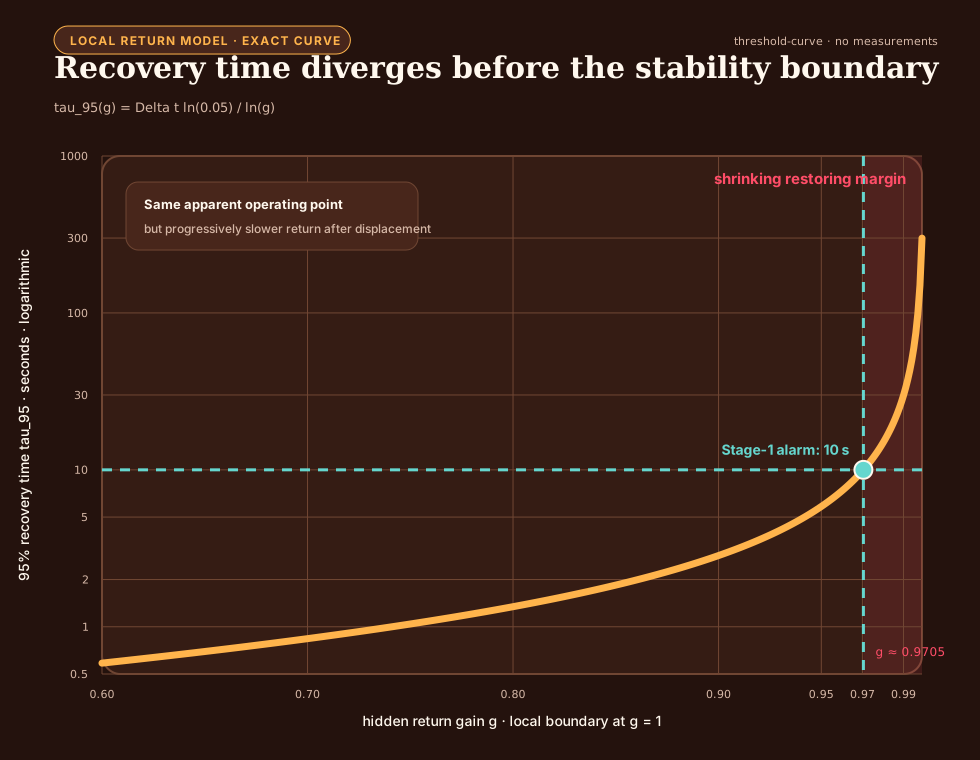
Snapshots answer whether a module is currently inside its envelope. Recovery dynamics ask how strongly it returns after a small displacement. The maintenance plane should begin with passive fluctuation analysis. If the state is a shadow or replica and the service budget permits it, a bounded probe can estimate return time or a local stability margin.
The proposed Stage-1 test is Candidate 003. It compares bounded recovery probes with SLO dashboards, queueing headroom, change detection, passive autoregressive estimates, and standard active system identification under equal budgets. If ordinary system identification performs as well, the system should use it; the design requirement is visibility into restoring dynamics, not a special biological estimator.
For the Candidate 003 linear simulator, the recovery-time curve is analytical. The ten-second line is its declared Stage-1 engineering threshold, not a biological constant, production alarm, or failure-time prediction.
Recovery is only one axis. A maturity record should expose at least:
| Dimension | Question | Example measure |
|---|---|---|
| temporal stability | Does behavior fluctuate under a stationary regime? | quality variance per event |
| acute resistance | How far does quality fall during a bounded perturbation? | maximum quality loss, fraction |
| recovery | How quickly and completely does behavior return? | return time, s or events |
| adaptability | How much work is required to learn a valid new regime? | updates, examples, and J |
| newcomer acceptance | Can a better candidate receive traffic and prove itself? | time to useful routing share, s |
| rollback | Can the prior behavior be restored after a failed change? | success fraction and lost work |
| reserve | What capacity remains for unexpected demand or repair? | bytes, W, routing slots, or RE/s |
These quantities must be reported separately before any aggregate resilience score is computed.
Structural health is a path-dependent capacity contract
A module or route can continue producing output after pruning, damage, drift, or overload while its remaining margin and next-event tolerance collapse. “Healthy,” “redundant,” “gracefully degraded,” and “reserve” are therefore not single scalar states.
For every structurally consolidated asset, record:
- damage or dependency posterior and cumulative load/use history;
- observation method, calibration, support, and detection limits;
- present capacity and post-contingency capacity in native units;
- surviving load/routing paths, common causes, and redistributed demand;
- permitted degraded-service vector, affected strata, and exposure duration;
- remaining time to a constraint boundary and available intervention;
- unload, isolation, reroute, repair, replacement, or rollback action;
- post-action verification; and
- restored next-event reserve rather than merely returned output.
Mechanism-qualified wear is a direct falsifier of endpoint-only health: equal cycle count or terminal wear volume can hide different damage histories, repair states, and remaining service (C-1500).
flowchart LR
    L["Load · demand · environment · use history"] --> S["Damage / dependency state"]
    S --> O["Sensors · inspection · observation support"]
    O --> I["Damage posterior + detection limits"]
    I --> C["Current + post-contingency capacity"]
    C --> R["Redistributed demand + common-cause set"]
    R --> G{"Qualified service and intervention window?"}
    G -->|"inside"| D["Declared degraded service vector"]
    G -->|"outside"| A["Unload · isolate · reroute · repair · replace"]
    D --> A
    A --> V["Post-action verification"]
    V --> N["Restored function + next-event reserve"]
    N --> L
The mechanics and network evidence in C-481–C-499 establish mature nulls and measurement boundaries, not an AI effect size. The combined contract in C-500 remains an experimental schema shared by Candidates 005, 012, and 014. It is rejected if ordinary mechanics/reliability, asset management, fault handling, and network assignment match it.
Efficiency mechanism
Maturity can reduce recurring work in four places:
- protected modules need fewer parameter writes, optimizer states, and global synchronization events;
- stable routing can use smaller decision surfaces and better placement;
- recurring subgraphs can become fused, quantized, compiled, or cached paths; and
- retirement can release whole tensors, memory pages, routing entries, and network transfers.
The benefit is physical only when the runtime uses the new structure. Zero weights inside a dense kernel and dormant experts that are still loaded or synchronized do not count as structural consolidation.
For a proposed consolidation serving future events, let and be steady runtime energy in joules per served event. Let , , , and be one-time energies in joules, let be expected recovery energy in joules including failed branches, and let be a dimensionless future-event count. Compare amortized energy per event:
against . The one-time numerator divided by and both runtime terms are joules per event, so the comparison is dimensionally closed. Storage, data movement, tail latency, quality, calibration, and risk remain separate constraints rather than being silently converted into energy.
A consolidation advances only if its observation horizon is long enough that and it improves or preserves the declared quality–risk–latency–resilience frontier. The expected recovery term must include failed branches and rollback, not only successful releases.
Evidence status
| Element | Status | What it supports here |
|---|---|---|
| delayed generalization as universal maturity certificate (C-011) | disputed | grokking cannot be the gate |
| competitive sparse subnetworks (C-012) | established in tested settings | staged pruning is a valid operator, not a universal policy |
| activity-sensitive developmental refinement (C-043) | established in the cited preparation | a slower maintenance process can participate in structural contraction |
| reopening mature plasticity (C-044, C-045) | established in the cited preparations | protection can be local and reversible under intervention |
| redundancy and newcomer engraftment (C-057) | plausible association | stability may obstruct beneficial replacement |
| recovery warning signals (C-058, C-059) | established in scoped ecological systems | restoring dynamics are worth testing as a fragility signal |
| multidimensional stability tradeoff (C-060) | established in the cited microcosms | resilience dimensions must remain separate |
| mechanics, residual capacity, damage tolerance, and redistributed network load (C-481–C-499) | established or plausible in scoped engineering models | mature nulls for structural health, reserve, and recovery |
| path-dependent residual-capacity contract (C-500) | speculative synthesis | cross-layer fault-injection schema only |
| complete digital lifecycle controller | speculative synthesis | requires isolated and composed experiments |
Speculative extensions
- Learn a lifecycle policy from logged promotion, rollback, and recovery outcomes while retaining hard provenance and safety constraints.
- Preserve cheap seed capacity outside the hot graph so retirement does not eliminate the ability to specialize under a future regime.
- Distill a coalition into a compact composite module, then retain the sources in a cold checkpoint until the composite survives a full recurrence cycle.
- Let recovery margin determine degrees of protection: lower update rate, narrower writable interfaces, or more stringent branch validation.
- Use capability-gap analysis to decide whether a failing mature module should reopen, be complemented by a newcomer, or retire.
- Reuse mature relational structure as a prior for faster consolidation while routing violations to a longer validation path.
Failure modes
- False maturity: a shortcut is stable on average and is protected before compositional, rare-event, or intervention tests expose it.
- Brittle maturity: quality remains inside its SLO while return time grows and the structure loses restoring margin.
- Maturity monopoly: protected redundant modules absorb all traffic and prevent a better newcomer from establishing evidence.
- Rare-function erasure: average routing and magnitude tests delete a path whose unique role appears only in a low-frequency or safety-critical regime.
- Reopening thrash: noisy triggers repeatedly create branches, retraining cost, and routing churn without a durable regime change.
- Rollback rot: checkpoints exist but dependencies, data schemas, or routing contracts have changed enough that restoration no longer works.
- Cosmetic sparsity: parameter count falls while bytes moved, kernel work, synchronization, and wall energy do not.
- Maintenance inversion: replay, probes, shadow traffic, migration, and regression testing consume more energy than mature execution saves.
- Scalar resilience: one score declares success while acute resistance, recovery, adaptability, or newcomer acceptance has deteriorated.
- Causal misattribution: a correlated low-usage path is pruned even though it stabilizes another module or handles a hidden confound.
- Hidden reserve loss: current output remains acceptable while damage, redistributed demand, common causes, or depleted intervention margin remove post-contingency capacity and next-event reserve.
Measurable predictions
- A vector maturity gate using causal contribution and cross-context tests preserves rare and intervention performance better than fixed schedules, magnitude pruning, or training-loss thresholds at matched retained capacity.
- Protected modules require fewer update joules and suffer less interference than continuously plastic modules, while branch-based reopening reaches a valid new regime with less regression than full unfreezing.
- Recovery features identify some hidden loss of stability margin before steady-state SLOs. They remain in the architecture only if they add value beyond passive monitoring and standard system identification at matched probe and compute cost.
- Structured consolidation lowers parameter bytes resident, bytes moved per event, communication, and measured joules together. Parameter reduction without those physical changes is rejected.
- Increasing redundancy improves some stability dimensions while degrading adaptation or newcomer admission in at least one controlled regime; the raw resilience vector reveals the tradeoff that a scalar score hides.
- Copy-on-write reopening plus rollback reduces catastrophic update loss relative to in-place adaptation after monitoring, checkpoint, and shadow costs are counted.
- Consolidation produces a net lifecycle energy benefit only above a measurable reuse horizon ; below that horizon, leaving the computation plastic or interpreted is cheaper.
- Residual-capacity fields predict unsafe second-event or redistributed-load failures beyond ordinary output, utilization, health, and redundancy scores; otherwise the cross-layer schema is removed.