- Purpose: freeze the source-shaped equations, support gates, event rules,
uncertainty treatment and endpoints for the
RSD-T02-PULSEwritten protocol - Claim: C-1561
- Primary source: Rahi et al. 2017,
bibliography key
rahi2017oscillatory - Evidence audit: repeated-stimulus pulse signatures
- Parent contract: intervention-qualified mechanism equivalence
- Experiment contract: Fixture F-026, RSD-T02-PULSE
- Authority: checked-in public-development constructor plus bounded panel
orchestrator;
NO_RESULT, no full-panel execution, actionable estimator, confirmation custody, workstation measurement or energy result
Inference boundary
This subtrack asks whether a repeated-stimulus response is a valid one-sided signature under a declared model and observation class. It does not infer a universal graph name.
The scoreable plant property is
Presence of a support-qualified stabilized refractory period or a
support-qualified subharmonic response can support against the
registered pure feed-forward rival. Absence produces unresolved; it never
proves . A measurement dead time, an undersampled output, a mixed
motif or a model outside the source assumptions cannot inherit the diagnostic.
This is a companion stratum to T02-MECH. It does not alter the exact
matched-step five-recipe bank and does not pretend that the source-shaped pair
below has that bank's canonical step equality. response_drives_inhibitor is
a subtrack-local causal coordinate; it must not be silently merged into
T02-MECH's reported_output_feedback_edge without a separate representation
map and intervention certificate.
Source-shaped planted pair
Let be a square pulse train in response units :
where pulse duration and onset-to-onset period are both in seconds and . The response and inhibitor are in . With , the protected response-driven negative-feedback world is
The paired input-driven incoherent feed-forward rival changes only the inhibitor drive:
Both start at the equilibrium . The reported scalar is
which is dimensionless. Equations (1) and (2) are the NFL 1 and IFFL 1
forms studied by Rahi et al., with the hard threshold replaced by the Hill
form that their systematic exploration also used. The protected synthetic
parameter manifest is
Those values lie on the source's enumerated parameter grid. Their behavior in this fixture is a construction target, not a result imported from the paper. Before any comparison run, a two-resolution construction certificate must establish every truth label and support gate below. Failure invalidates the world version; it does not permit threshold tuning after inspection.
Rahi et al. used a first-order downstream output node driven by powers of in this smooth-model exploration. At periodic steady state, its time average is proportional to the time average of its drive. Equation (3) therefore retains the same refractory argmax while event extraction remains on itself. This is a fixture simplification, not a claim that the transient output nodes are identical.
Step adaptation and pulse support
For a step , let
and let be the certified late-time value. The source-shaped adaptation gate is
The refractory analysis may use only durations satisfying
For each duration, an isolated pulse followed by a washout defines the response-amplitude reference
The registered event threshold is the protocol convention
Thresholds and are sensitivity diagnostics only. A pulse cell is in support only if all of the following hold:
- Equation (5) passes and the off-state equilibrium is recovered before the first pulse, meaning after washout.
- exceeds five times its numerical error bound.
- A single isolated pulse causes exactly one registered upward crossing of before washout. Zero or multiple response cycles are outside the source-shaped single-response region.
- The pulse edges are represented exactly by solver stops and the observation cadence resolves every threshold crossing with a latency error bound.
- No saturation, clipping, censoring, output dead time, undocumented filter or future sample changes the event word.
The source's lower boundary - insufficient inhibitor accumulation - and upper boundary - more than one response to one long pulse - are therefore explicit support failures rather than favorable or unfavorable observations.
Refractory-period stabilization
After convergence, define the cycle-averaged output over complete cycles:
Use after the convergence time . For fixed , the refractory period is
If several periods are tied within the certified output error, retain the full maximizer interval and report its largest member only as a descriptive value. The decision must propagate the complete interval.
The protected stabilization panel is
For each , scan from through at spacing, then refine the two coarse neighbors around every tied maximum at spacing. This response-dependent refinement rule is frozen before outputs and is applied to every world.
Let be the error-qualified maximizer interval. For adjacent durations , the conservative secant-slope interval is
Refractory stabilization is certified only if at least two consecutive support-qualified intervals satisfy
The slope is dimensionless. A maximizer touching the boundary, an
unresolved maximizer interval, a duration violating (6), or a cell with more
than one response to one pulse makes stabilization unresolved.
Response count and latency
For pulse , let be the number of upward crossings of in . Define
where is a count and is the stimulus count. The first crossing latency is
in seconds. A missing event has no latency; it is not encoded as zero or . Report the observed values, missing-event count, event amplitude and all . A cell with any fails the single-response support gate.
Period skipping
The protected skipping cells use
These are synthetic protocol choices. For , compare the complete state and output waveforms over one stimulus period after convergence:
The scale is for and and one for . Let be the two-resolution bound for . Period skipping is certified only when all of these conditions hold:
- the smallest certified recurrence order is in ;
- while ;
- the event word of length contains at least one response and at least one skipped pulse and repeats for four complete cycles;
- every included pulse has ; and
- the direct plant output, not a censored or aliased observation, supplies the event word.
If no converges before the time cap, the state is unresolved, not
aperiodic NFL and not IFFL. The largest consecutive zero run, ,
, latency distribution and recurrence residuals are
secondary outputs.
Checked-in construction snapshot
The deterministic constructor in
rsd-t02-pulse.mjs
now implements the six-world registry, exact pulse-edge stops, adaptive
Dormand--Prince 5(4) integration, the two-resolution gates, recurrence orders
, event extraction, bounded refractory search, typed costs and
fail-closed NO_RESULT records. Its focused test suite covers the protected
feedback/feed-forward pair, the signature-negative linear feedback world,
dead-time and alias hostiles, deterministic OU diagnostics and malformed
paths.
One executed construction cell at and gives:
PS-NFL-H4: a support-qualified order-two recurrence, event word01repeated ten times, 10 responses from 20 stimuli, recurrence upper bound and first-response latencies near ;PS-IFFL-H4: order-one recurrence and an absent skipping signature; and- an unresolved topology disposition for both records. Signature presence is evaluator construction truth, not an actionable inference result.
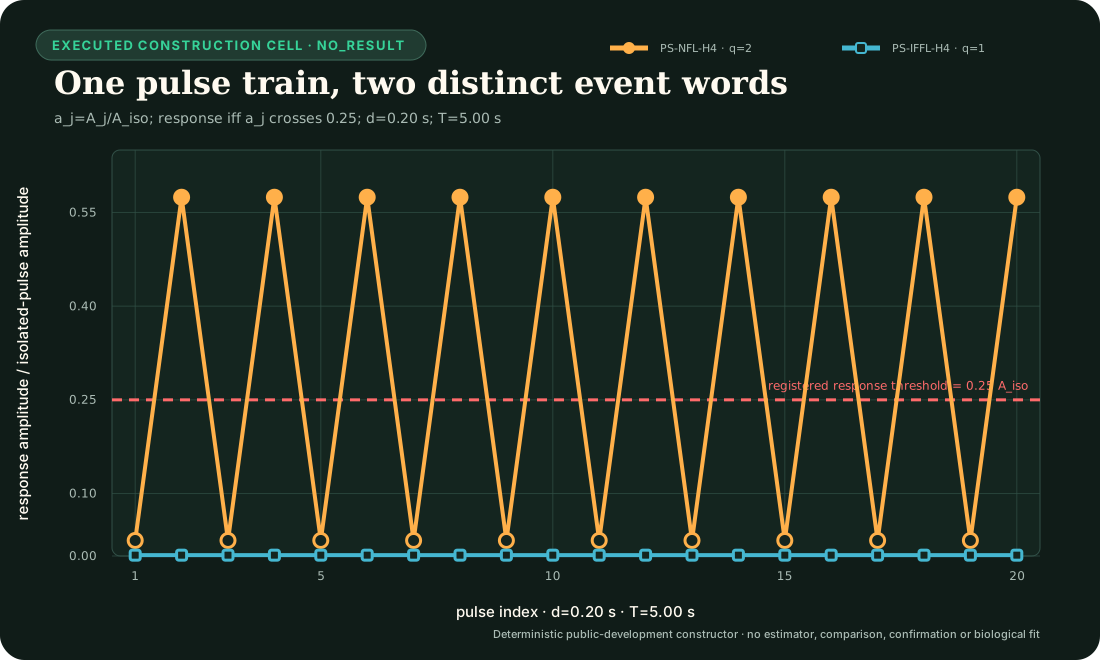
The figure is generated from the constructor itself by
generate-plots.mjs; its editable parameters
are in core-models.json. Filled amber
markers cross the registered response threshold on every second feedback-world
pulse. The cyan feed-forward trace remains below threshold. This is one public
development cell, not a biological fit, estimator comparison or confirmation
result.
A separate bounded diagnostic scan for PS-NFL-H4 at
evaluated 198 coarse and 38 refined cells and retained the
interior maximizer interval . That single duration
cannot establish stabilization: equation (12) needs adjacent duration slopes.
The six-duration refractory panel, 64-seed noise grid and mixed-window panel
remain unexecuted.
The separate
rsd-t02-pulse-panel-runner.mjs
freezes an ordered 229-unit execution plan:
- four mixed-window contract records that remain unresolved while window starts or widths are unfrozen;
- 18 refractory units from three worlds × six durations;
- 15 skipping units from five worlds × three periods; and
- 192 robustness units from 64 public seeds × three OU noise levels, each targeting the deterministic panel only after its construction gates pass.
The runner defaults to zero work and permits at most eight units per invocation. Its append-only resume identity binds the exact config, schedule, runner, constructor and event-schema bytes plus the Node/V8/libuv and host runtime fingerprint. A 16 MiB per-unit cap and 256 MiB whole-run cap apply to serialized results. The built-in executor can construct refractory and skipping units; clean-sample OU production remains external and mixed windows remain deliberately unresolved. No 229-unit run was started. Static imports are loaded before their source files are fingerprinted, so same-process source mutation across that load/read interval remains outside this public construction boundary.
Null and counterworld bank
The versioned bank contains the following independent cases.
-
PS-NFL-H4: equations (1), (3) and (4). Its positive signature status must be established by a construction certificate before it enters any scored partition. -
PS-IFFL-H4: equations (2), (3) and (4). It is the paired pure feed-forward rival. Any feedback assignment in this world is a false attribution. -
PS-NFL-LTI: a signature-negative feedback control,This stable linear negative-feedback system adapts its signed response to zero but entrains to a periodic input. It checks that absence of the nonlinear signatures remains
unresolvedinstead of being converted to an IFFL declaration. -
PS-MIXED: the source's parallel slow-IFFL/fast-NFL counterworld. Use dimensionless states and normalized time :with , , , and . Under the registered one-second normalization, evaluate over windows ending at and . A window-dependent signature reports
mixed/window-qualified, never a single exclusive graph. -
PS-DEADTIME: the direct plant isPS-IFFL-H4, but the observation layer suppresses reported events for after every detected event. The resulting apparent skip pattern is a calibrated measurement-recovery artifact and must fail the observation support gate. -
PS-ALIAS: the direct plant isPS-IFFL-H4, but the reported cadence is at a fixed phase. It cannot bound event count or latency and must fail temporal-resolution support.
The graph, equations, parameters, direct-versus-observed channel and counterworld identity are evaluator-only. Actionable arms receive causal input, reported output, timestamps, units, missingness and registered instrument metadata. They do not receive the truth label or future samples.
Numerical construction certificate
The checked-in constructor uses binary64 integration with exact stops at pulse edges. Its adaptive Runge--Kutta reference run uses absolute tolerance for state variables and relative tolerance ; the refinement run halves both tolerances. The certificate retains maximum state/output disagreement, quadrature disagreement, threshold-crossing time disagreement and recurrence-residual disagreement.
Convergence is tested immediately before pulse onset. The state must recur to
fractional scaled error for or the smallest , and the
same recurrence must persist for four additional cycles. Total simulated time
is capped at per cell. Nonconvergence, solver failure,
nonfinite state, negative concentration in a concentration-qualified world or
refinement disagreement produces unresolved or malformed; it is never
silently dropped.
No fixed numerical value in this note is an empirical biological tolerance. Equations (7), (10), (15), the solver tolerances and the finite time cap are synthetic protocol choices.
Endpoints and decision
The primary outputs are separate:
refractory_signaturein{supported, absent, unresolved, out_of_support}using (12);skipping_signaturein the same set using (16);feedback_supportin{supported, unresolved, contradicted, out_of_support}; and- false feedback attribution on
PS-IFFL-H4,PS-DEADTIMEandPS-ALIAS.
feedback_support=supported requires at least one positive signature, all of
its support gates, and a certified source-class rival. Two absent signatures
yield unresolved. PS-NFL-LTI is correct only when the method abstains.
PS-MIXED is correct only when the output retains the window qualification.
Report response count, stimulus count, seconds of latency, in seconds, dimensionless slope, recurrence order, recurrence residual, simulated seconds, pulse cells, samples, bytes, solver evaluations, scalar operations, retained-state bytes, wall seconds and later calibrated joules as separate fields. No scalar efficiency score is registered.
Kill rules
Kill a claim-eligible use of this subtrack if any of the following occurs:
- one isolated pulse, graph identity or evaluator-only parameters supply the answer;
- absent signatures are scored as evidence for feed-forward structure;
- , insufficient adaptation or multiple responses per pulse are retained in the stabilization denominator;
- a boundary maximum or unresolved maximizer interval is converted to a point estimate;
- a dead-time or aliased observation is called plant feedback;
- a mixed motif is forced into one exclusive topology;
- event thresholds, duration cells, period cells or convergence order are changed after output inspection;
- malformed/nonconverged cells are deleted; or
- construction checks are presented as a comparison, biological prevalence, workstation or energy result.
Disposition
This note and its checked-in module complete a bounded construction layer for
C-1561. The bounded panel schedule and append-only runner now exist, but they
do not complete the six-duration and robustness executions, the mixed-window
statistic, actionable estimator comparison, prospective confirmation partition
or workstation execution. The only current authority is public-development,
construction-only and NO_RESULT.