Scope
This chapter defines how the project may borrow from living systems without turning a biological implementation into a specification. The brain is an existence proof for efficient adaptive intelligence, but neither evolution nor neural tissue optimized the same objective, hardware, scale, or reliability contract as an artificial system.
The working rule is:
Reproduce the useful constraint or computation, not the substrate accident.
Biological observation
Biological intelligence is shaped by slow, noisy, failure-prone components; metabolically expensive communication; physical growth; local chemical signals; and an inability to checkpoint, clone, or roll back a whole organism. Brains compensate with local processing, sparse activity, redundancy, specialized cell types, multiple timescales, and continual maintenance.
Those compensations are informative, but they are not automatically optimal on silicon. Digital systems offer different capabilities: fast switching and interconnect, exact copying, explicit addressing, external storage, reversible experiments, global synchronization when it is worth its cost, and precision that can be selected per operation. At the same time, digital systems still pay heavily for data movement, memory access, communication, cooling, and idle capacity. The relevant question is which constraints and useful computations survive a change of substrate.
The speed comparison must stay qualitative until a shared task and latency boundary exist. Axonal conduction, synaptic integration, transistor switching, GPU kernels, and cluster collectives are different operations. Selecting the fastest number from each domain would recreate the invalid comparison rejected by C-016.
Proposed AI translation
For each biological candidate, record five transformations:
- Observed function: what the organism demonstrably achieves.
- Biological constraint: which physical or evolutionary limit shaped it.
- Candidate invariant: the computation that may survive a substrate change.
- Silicon implementation: the least literal engineered mechanism that tests the invariant.
- Escape hatch: the biological limitation that engineering should not inherit.
| Biological pattern | Candidate invariant | Silicon-native escape hatch |
|---|---|---|
| Mostly local signaling | Price communication and keep repeated work near its state | Permit fast global exchange when its measured value exceeds its traffic cost |
| Slow, noisy spikes | Event-driven, uncertainty-sensitive updates | Use dense vector arithmetic or exact digital state where it is cheaper |
| Synaptic and dendritic computation | Compute near stored state; route locally before global aggregation | Implement fused kernels, hierarchical memory, or programmable modules rather than literal morphology |
| Sleep and replay | Separate acquisition from protected integration | Consolidate asynchronously, continuously, or from exact checkpoints |
| Development and pruning | Explore with reversible capacity, then commit after evidence | Grow, clone, roll back, and reallocate modules without waiting for physical development |
| Multiple memory systems | Match update rate and provenance to information lifetime | Use databases, caches, logs, tools, and versioned weights unavailable to animals |
| Homeostasis and repair | Treat stability and maintenance as active control loops | Use telemetry, deterministic tests, redundancy, and replacement hardware |
This transformation is a project decision, not evidence that any row will produce a gain. The candidate inventory is maintained in the neuroscience opportunity map and comparative-biology map. Its relationship to existing AI is tracked in the adoption matrix.
Efficiency mechanism
The approach preserves useful functions in the cheapest available form and uses digital capabilities—including exact copies, reversible branches, and direct addressing—where they improve the measured system.
For a biological candidate , the engineering experiment compares at least three systems: a conventional baseline , a literal or close biological translation when meaningful, and a silicon-native abstraction . Using the measurement contract from the energy model, the candidate is interesting only if improves the quality–risk–energy frontier:
where is task quality, is the declared risk metric, is energy within the declared boundary, and is latency. The symbol means Pareto dominance under pre-registered tolerances; it does not collapse unlike units into a decorative score.
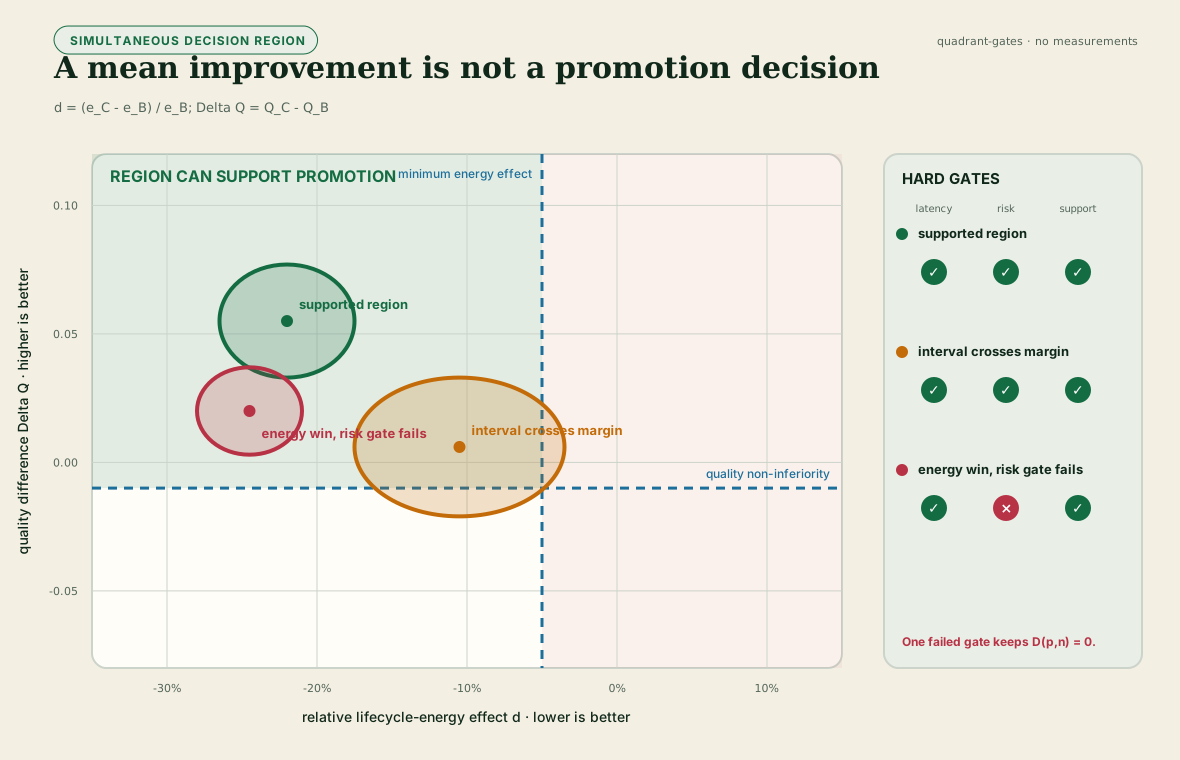
The decision geometry below is illustrative. Its points and simultaneous regions are not measurements; they show why a favorable mean on one coordinate cannot override uncertainty or a failed protected-outcome gate.
Evidence status
- Neural energy constraints are established only within the scope of C-001.
- Nonlinear dendritic subunits, homeostatic scaling, neuromodulated plasticity, and specialized inhibitory control are biological observations under C-017 through C-020; their proposed artificial abstractions are not thereby validated.
- Performance of the complete cross-substrate system remains speculative until matched engineering tests establish it.
Speculative extensions
- Learn when global communication is worth buying instead of banning it.
- Compile frequently reused local circuits into fast deterministic paths while retaining a slower plastic path for exceptions.
- Search jointly over algorithm, memory hierarchy, interconnect, precision, and physical embodiment rather than treating hardware as a final deployment detail.
- Import organizational principles from organisms without centralized brains, including plants, immune systems, cephalopod limbs, and adaptive transport networks.
Failure modes
- A metaphor is mistaken for a mechanism.
- “Biological” becomes an unearned synonym for efficient or intelligent.
- “Silicon is faster” is used to ignore memory movement, synchronization, or thermal limits.
- A negative result for one implementation is treated as falsifying the underlying biological abstraction—or vice versa.
- The project claims an idea is absent from AI after finding only that it is absent from mainstream foundation models.
- Evolutionary fitness is confused with task accuracy, truthfulness, or human values.
Measurable predictions
This framing earns its place if, across isolated mechanism experiments:
- silicon-native abstractions equal or outperform literal translations at matched quality and system boundary;
- retained biological constraints predict where energy or interference is saved;
- removing a proposed invariant removes the benefit even when the biological surface form remains; and
- at least one hybrid uses a capability unavailable to biology—such as exact rollback or external versioned memory—to improve continual learning without increasing the declared risk metric.